Every seasoned project manager knows that a construction site is a delicately balanced ecosystem. When that balance is maintained, the project hums along with rhythmic efficiency, hitting milestones, staying under budget, and keeping stakeholders satisfied. However, when the balance is disrupted—often due to poorly planned machinery procurement—the consequences are immediate and severe. The hidden costs of improper procurement planning are staggering. A single idle day caused by missing or malfunctioning machinery can trigger a domino effect: laborers stand around with nothing to do, sequential trades are pushed back, strict budgets are blown apart by overtime requirements, and critical deadlines are missed, potentially incurring heavy liquidated damages.
Sourcing the right machinery is not simply a matter of finding the vendor with the lowest daily rate. It is a highly strategic endeavor that requires project managers to match specific mechanical capabilities to the exact conditions, timelines, and logistical constraints of their specific site. A machine that is perfect for a sprawling, flat suburban development might be entirely useless—or even dangerous—on a cramped, uneven urban infill project.
This comprehensive guide is designed to provide you with a strategic blueprint for auditing your site needs, thoroughly vetting vendors, managing complex logistics, and ensuring your project keeps moving efficiently from the initial groundbreaking all the way to the final handover. By applying these methodologies, you can protect your profit margins, ensure the safety of your crew, and deliver a successful build.
Map Out Your Site Requirements Before Contacting Vendors

Before you ever pick up the phone or send out a Request for Proposal (RFP) to a vendor, you must have an intimate, granular understanding of what your site actually demands. Rushing into the procurement phase without a solid plan often leads to over-specifying (paying for power or reach you do not need) or under-specifying (getting a machine that cannot safely perform the required tasks).
Conduct a Phase-by-Phase Site Audit
A successful procurement strategy requires you to break down your master project timeline into distinct, manageable phases. By analyzing the excavation, framing, roofing, and finishing phases separately, you can pinpoint the exact weeks or months specific machinery will be required.
-
Excavation and Earthmoving: Determine the volume of soil to be moved and the density of the earth. This dictates the size of the excavators and articulated dump trucks required.
-
Foundation and Concrete: Assess the reach required for concrete boom pumps and the staging areas for mixers.
-
Framing and Structural Work: Evaluate your material handling needs based on the surface conditions of your site. If your site is unpaved, muddy, or deeply rutted, you will need rough-terrain telehandlers. Conversely, once the concrete slab is poured and you are moving palleted materials indoors, standard warehouse forklifts will be much more appropriate and cost-effective.
-
Finishing and Enclosure: Identify the need for scissor lifts, articulating boom lifts, and specialized glazing manipulators.
Match Machinery Specs to Site Constraints
Your site’s physical limitations are just as important as the tasks you need to perform. You must conduct a thorough physical survey of the environment to avoid costly mismatches.
-
Space Limitations: Measure gate widths, turning radii in staging areas, and the distance between temporary structures. A machine with a wide wheelbase might have excellent stability but could be entirely trapped in a narrow urban alleyway.
-
Ground-Bearing Pressure: Analyze the soil reports. Heavy tracked machinery exerts different ground pressure than wheeled machinery. Placing machinery that is too heavy on soft soil can lead to sinking, tipping, or damage to underground utilities.
-
Overhead Clearance: Map out existing power lines, tree canopies, and adjacent building overhangs.
Consulting with top-tier equipment rental services early in your planning phase is highly recommended. These professionals have deep technical knowledge of their fleets and can often suggest multi-purpose machines—such as a backhoe loader with various attachments—that can perform the jobs of three separate machines, thereby saving you money and drastically reducing site clutter.
Crunch the Numbers on Ownership vs. Temporary Use
One of the most persistent dilemmas in construction management is deciding whether to buy machinery outright or rely on temporary procurement. Both models have their distinct advantages, but making the wrong choice can tie up essential capital or lead to exorbitant daily fees. Making this decision requires a cold, hard look at your utilization rates and long-term business projections.
Calculate Your Utilization Rate
The most critical metric in the buy-versus-borrow debate is the utilization rate, which represents the percentage of time a machine is actively working on a site compared to the time it sits idle.
-
The 60% Rule-of-Thumb: Industry standards generally suggest that if you project a machine will be utilized less than 60% to 65% of the time over its lifespan, temporary sourcing is the superior financial choice.
-
Total Cost of Ownership (TCO): When calculating ownership, you must factor in much more than the sticker price. TCO includes depreciation, financing interest, storage costs, comprehensive insurance policies, property taxes, and the cost of transporting the machine between different job sites.
-
Flexibility and Scale: Utilizing external vendors allows you to scale up or down instantaneously. For instance, if your schedule suddenly accelerates and you need to move a massive amount of masonry block in a single week, relying on forklift rentals for short-term material staging provides maximum flexibility without committing you to a decade of maintenance payments.
Segregate Consumables and Hand Gear from Heavy Machinery
A sound financial strategy segregates massive capital expenditures from daily operational tools. While it rarely makes sense to purchase a massive bulldozer for a single project, relying on vendors for everyday hand tools is an easy way to bleed your budget dry.
-
The Case for Purchasing High-Use Gear: Handheld gear, safety equipment, and standard power tools should almost always be purchased outright. Your crews use these items every single day, and the cumulative daily fees for borrowing them will quickly surpass their retail purchase price.
-
Negotiating Bulk Deals: Instead of buying tools ad-hoc at big-box hardware stores, project managers should strategically align with dedicated commercial power tool suppliers early in the year. By forecasting your annual need for drills, circular saws, rotary hammers, and portable generators, you can negotiate significant bulk-purchase discounts. This ensures your crew is always equipped with high-quality, reliable gear without eating into the budget reserved for heavy earthmoving machinery.
-
Standardization: Buying from a single supplier allows you to standardize your battery platforms. When all your drills, saws, and grinders run on the same 20V battery system, you eliminate the chaos of managing dozens of different chargers on site.
Vet Maintenance Protocols to Prevent Costly Downtime
Even the most meticulously planned project schedule will unravel if a critical piece of machinery breaks down in the middle of a crucial task. When you procure machinery, you are not just paying for the iron; you are paying for reliability. Therefore, vetting a vendor’s maintenance protocols is arguably more important than negotiating their daily rates.
Demand Transparent Service Logs and Breakdown Policies
Before signing a contract, you must investigate how the vendor treats their fleet. A fresh coat of yellow paint can hide a multitude of mechanical sins.
-
Preventative Maintenance Schedules: Ask potential vendors to provide documented service logs for the specific machines they intend to send to your site. Verify that they follow the original equipment manufacturer (OEM) guidelines for oil changes, hydraulic fluid flushes, and track tensioning.
-
Fluid Analysis: High-tier vendors perform regular fluid analysis to detect microscopic metal shavings in the oil, which is a leading indicator of an impending engine or transmission failure.
-
Service Level Agreements (SLAs): What happens when a machine fails? Your contract should clearly state the maximum acceptable downtime. You must ensure your vendor has a rapid-response heavy equipment repair company on call to dispatch field mechanics immediately. If a crucial concrete pump fails while mixing trucks are lined up on the street, waiting three days for a mechanic is not an option; you need a technician on-site within hours.
Prepare an On-Site Contingency Plan for Minor Snags
While catastrophic engine failures require specialized mechanics, many site delays are caused by minor, predictable snags—especially those related to weather and ground conditions.
-
Weather Mitigation: Sudden torrential rain can turn a hard-packed site into a muddy swamp in minutes. Wheel loaders and skid steers frequently lose traction and become immobilized.
-
On-Site Recovery Readiness: Waiting half a day for a vendor to send a recovery vehicle for a machine stuck in the mud is a massive waste of paid labor hours. Project managers should proactively stage proper towing equipment and supplies directly on the site. Keeping heavy-duty recovery straps, high-tonnage shackles, and traction mats readily available ensures that if a machine bogs down, your crew can safely pull it out and get back to work immediately without relying on external help.
-
Daily Walk-Arounds: Mandate that your operators perform a documented 10-minute walk-around inspection every morning. Catching a frayed hydraulic line or a soft tire before the machine starts working is the easiest way to prevent a mid-day shutdown.
Plan Safe and Efficient Vertical Lifts
Lifting hundreds or thousands of pounds into the air represents the highest-risk activity on any construction site. Gravity is unforgiving, and the margin for error during a vertical lift is essentially zero. Sourcing the machinery for these operations requires a rigorous, almost obsessive attention to detail, mathematics, and safety compliance.
Analyze Your Architectural Drawings for Load Capacities
You cannot order hoisting machinery based on guesswork. Every lift must be mathematically proven before the machine arrives on site.
-
Understanding Load Charts: Project managers must know how to read and interpret complex load charts. A machine’s maximum lifting capacity is not a static number; it changes drastically based on the boom angle, the extension length, and the radius from the center of the turntable.
-
Calculating the Worst-Case Scenario: Identify the heaviest objects you need to lift—such as rooftop HVAC units, precast concrete panels, or massive structural steel beams—and calculate the maximum radius at which they must be placed.
-
Right-Sizing the Machine: Using this data is critical when seeking out crane rentals for your site. Over-sizing the machine wastes thousands of dollars in unnecessary fees and requires a larger footprint. Conversely, under-sizing the machine is a catastrophic safety hazard that can lead to tipping, boom collapse, and fatal accidents.
Prioritize Operator Certifications and Turnkey Solutions
The physical machine is only half of the equation; the human operating the levers is equally important. When sourcing this specific type of machinery, you must carefully consider liability, insurance, and skill levels.
-
Bare Rentals vs. Operated Agreements: A “bare rental” means you simply lease the machine and provide your own operator. While cheaper upfront, you assume 100% of the liability for the lift, the rigging, and the machine’s safety.
-
Mitigating Risk: For complex vertical lifts, especially those occurring in tight urban corridors or over existing structures, it is highly advisable to opt for a comprehensive, fully managed crane service instead. These turnkey agreements include the delivery of the machine, highly specialized rigging crews, and OSHA-certified operators who perform these exact lifts every single day. By transferring the operational risk and liability to a specialized contractor, project managers can focus on the broader site logistics while knowing the most dangerous task is being handled by dedicated experts.
-
Lift Plans: Ensure your vendor provides a 3D lift plan for critical operations, taking into account wind speeds, ground stabilization with proper outrigger pads, and overhead hazards.
Coordinate Transportation and Site Access Early
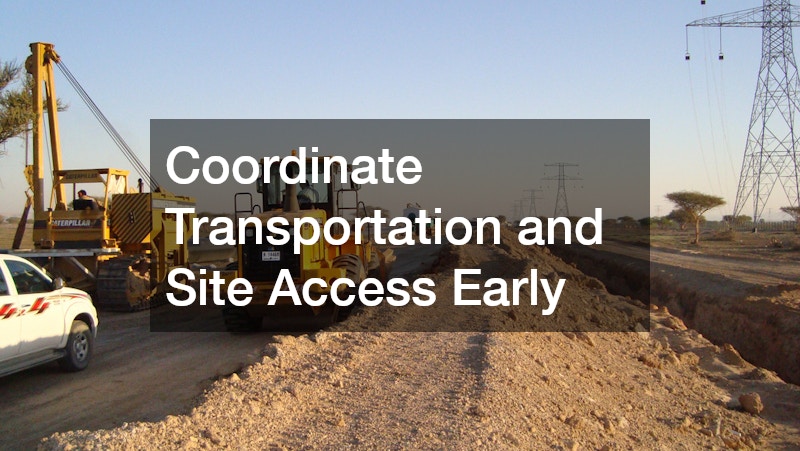
A common, yet devastating, oversight in procurement planning is finalizing a great deal on a piece of machinery without considering how it will physically get to the job site. Moving massive steel structures across the country is a logistical puzzle that involves municipal governments, highway patrols, and precise timing.
Plot Wide-Load Routes and Navigate Municipal Permits
Standard flatbed trucks can move smaller skid steers and mini-excavators without issue, but transporting massive earthmovers or crawler machines is an entirely different undertaking.
-
The Bureaucracy of Transportation: Moving heavy machinery across state lines, over bridges with strict weight limits, or through dense urban centers requires meticulous planning. You must account for Department of Transportation (DOT) regulations, height restrictions under overpasses, and municipal noise ordinances.
-
Securing Specialized Transport: Because the fines for moving unpermitted overweight loads are astronomical, partnering with specialized heavy equipment hauling services is non-negotiable. These specialized logistics companies handle the bureaucratic nightmare for you. They secure the correct oversize and over-dimensional permits, coordinate police escorts if necessary, provide pilot cars with height poles, and map out routes that avoid low-hanging power lines and weight-restricted rural bridges.
-
Curfews and Timing: Many municipalities restrict wide-load movements to specific nighttime hours to avoid traffic congestion. Your site must be prepared with proper lighting and staff to receive the machinery at potentially odd hours.
Source Geographically to Cut Down on Mobilization Fees
The cost of transporting a machine from the vendor’s yard to your site (mobilization) and back again (demobilization) can sometimes eclipse the actual daily cost of the machine itself.
-
Factoring Freight into the Bid: When evaluating bids from different vendors, you must look at the total landed cost, not just the base operational rate. A vendor located three states away might offer a daily rate that is 15% cheaper, but the cross-country freight charges will instantly negate those savings.
-
The Geographic Advantage: Sourcing as close to your job site as physically possible is a proven strategy for protecting your budget. Utilizing a local crane rental vendor, for example, will drastically reduce exorbitant drop-off and pick-up fees. Furthermore, local vendors are highly familiar with the regional permitting processes, understand the local soil conditions, and can dispatch replacement parts or mechanics much faster than a vendor located hundreds of miles away.
-
Site Preparation for Delivery: Ensure your site access points are prepared before the lowboy trailer arrives. Clear away debris, ensure the ground is stable enough to support the transport truck, and have a designated staging area ready so the delivery driver can drop the machine and leave without delaying the rest of your operations.
Conclusion
Mastering the art of machinery procurement goes far beyond scrolling through a vendor catalog and looking for the lowest price. It is a fundamental pillar of project management that demands rigorous early planning, highly detailed site audits, and meticulous logistical coordination. By taking the time to accurately calculate your utilization rates, demanding transparent maintenance logs, and carefully planning your heavy lifts and transportation routes, you transform procurement from a simple purchasing task into a strategic advantage.
When you treat your vendors as partners rather than just suppliers, and when you prepare for the inevitable snags with strong on-site contingencies, you insulate your project from the cascading delays that plague so many builds. Remember, the effort you invest in the sourcing phase pays massive dividends in site safety, crew morale, and budget preservation. As you prepare for your next groundbreaking, prioritize these methodologies, download a comprehensive procurement checklist, and ensure that when your crew arrives on site, the right tools are ready and waiting to build your vision.